
Here is something most affiliate marketing articles will not tell you: the gap between what beginners expect and what they actually earn with affiliate marketing income in the first year is enormous.
Online forums and affiliate communities are full of people who started with high hopes, published consistently for months, and still found themselves staring at single-digit commission reports.
That experience is far more common than the six-figure success stories that tend to dominate search results. According to discussions across major affiliate marketing communities on Reddit, Facebook groups, and platforms like Affilorama and Authority Hacker, the overwhelming majority of beginners earn under $500 in their first six months. That is not failure. That is the normal trajectory of a business that rewards patience and compounds over time.
This guide gives you the honest, grounded picture based on documented case studies, published income reports, and data shared across the affiliate marketing industry. No manufactured anecdotes, just realistic expectations and the strategies that actually work in 2026.
“The difference between affiliates who quit and affiliates who succeed is not talent. It is accurate expectations and the patience to outlast the slow start.”
By the end of this article, you will know exactly what to expect at each stage, from your first month to your third year, along with the factors that can dramatically accelerate your results.
What Is Affiliate Marketing? (A Quick, Human Overview)
How It Actually Works
Affiliate marketing is straightforward in concept: you recommend a product or service, someone buys through your unique link, and you earn a commission. You do not handle inventory, customer service, or fulfillment. You are essentially a matchmaker between a buyer and a seller.
In practice, most affiliates build an audience through one or more of these channels:
- A blog or niche website with SEO-driven content
- A YouTube channel with tutorials, reviews, or comparisons
- A Pinterest account driving evergreen traffic to articles
- Social media (Instagram, TikTok, X) for direct recommendations
- An email list, which consistently converts at higher rates than most other channels according to industry benchmarks
The real art is creating content that genuinely helps people make a decision, then being there with your affiliate link when they are ready to buy.
Common Affiliate Platforms to Know
You do not need to join every network. Here are the major ones worth knowing:
- Amazon Associates: huge product catalog, lower commissions (1-4%), high conversion rates due to brand trust
- ClickBank: digital products, high commissions (30-75%), variable product quality
- CJ Affiliate (Commission Junction): large brands, solid reliability across many categories
- ShareASale: great for physical and SaaS products across a wide range of niches
- Impact: home to many premium SaaS and software programs with strong recurring payouts
How Much Can Beginners Realistically Make?
This is the question everyone asks first, and the honest answer is: it depends on too many variables to give one number. But realistic ranges exist based on what affiliate communities, published income reports, and industry research consistently show.
First 3 Months: The Humbling Phase
Most beginners make between $0 and $100 in their first three months. Sometimes nothing at all. Published data from affiliate marketing surveys and community polls backs this up consistently: a large majority of affiliates report earning under $100 in their first quarter.
This is not failure. The first three months are almost entirely a learning phase. You are figuring out SEO, understanding what content resonates, learning how to write for buyer intent, and waiting for search engines to even index and rank your content. Expecting significant commissions this early is like expecting a harvest the week after planting seeds.
“Beginners commonly report that their first commission, however small, changed their mindset entirely. Not because of the money, but because it proved the model actually works.” – Affiliate marketing community sentiment, documented across multiple forums
Focus in this phase: consistency over volume, learning over earning, and building the foundation that will pay off later.
After 6-12 Months: The First Traction
This is where things start to get interesting for people who have not quit. Realistic income at this stage ranges from $300 to $2,000 per month, with the wide variance driven by:
- Niche selection: high-ticket niches grow faster in dollar terms
- Publishing frequency: more quality content means more opportunities to rank
- Content quality: genuinely helpful, expert content outranks thin filler
- Traffic source: SEO takes longer but scales better; social can move faster initially
Multiple published case studies from affiliate marketers who document their journeys publicly show this 6-12 month window is where the first meaningful income appears for consistent publishers. Many report coming close to quitting around month 4 or 5, only to see significant growth between months 6 and 12.
After 1-3 Years: When It Gets Serious
Affiliates who stay consistent for two or more years often find themselves earning $5,000 to $50,000 or more per month. This is not a guarantee, and it depends heavily on niche, strategy, and traffic diversification. But it is where the real passive income potential becomes tangible.
At this stage, content published two or three years prior continues driving commissions every month without additional work. That compounding effect is what makes affiliate marketing a genuinely attractive long-term model.
Affiliate Marketing Income Statistics in 2026
Income Breakdown by Experience Level
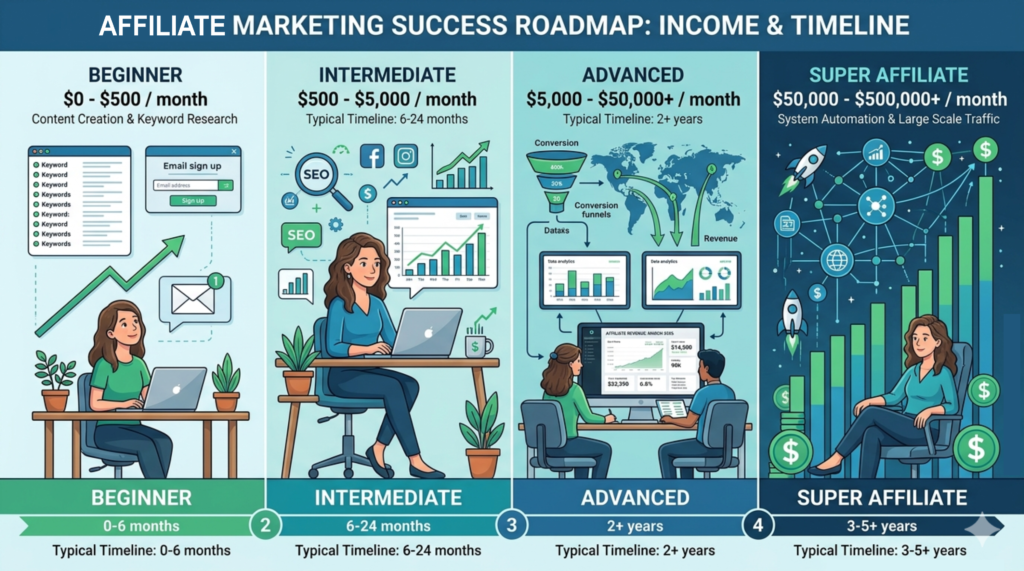
| Experience Level | Monthly Income Range | Typical Timeline |
| Beginner | $0-$500/month | 0-6 months |
| Intermediate | $500-$5,000/month | 6-24 months |
| Advanced | $5,000-$50,000+/month | 2+ years |
| Super Affiliate | $50,000-$500,000+/month | 3-5+ years |
Note: These are realistic ranges based on community-reported data and published case studies, not guarantees. Individual results depend heavily on niche, effort, and strategy.
What About Super Affiliates?
Screenshots of $100,000 per month exist and are legitimate, but they represent a tiny fraction of the affiliate marketing world. Super affiliates at this level typically have:
- Large, well-established content libraries of hundreds or thousands of articles or videos
- High-converting email lists of tens of thousands of subscribers
- Paid advertising budgets reinvested from existing commissions
- Teams helping create and distribute content at scale
These cases are real but rare. They represent the top fraction of a large and competitive field. Knowing that should calibrate your timeline, not discourage your start.
The Factors That Actually Determine Your Income
Your Niche: The Single Biggest Lever
Nothing impacts your affiliate marketing income ceiling more than the niche you choose. High-paying niches exist because companies in those industries earn large amounts per customer and can afford to pay affiliates well.
High-earning niches include:
- Personal finance: credit cards, investing, insurance (commissions often $50-$500 per lead or sale)
- Software and SaaS: recurring commissions, often 20-40% monthly revenue share
- Health and wellness: supplements, fitness programs, medical devices
- Business tools and productivity software: high lifetime value customers
Lower-earning niches are not necessarily bad choices, but you will need substantially more traffic to generate equivalent income. A $3 commission requires roughly 100 times the sales volume of a $300 commission. That math shapes your entire strategy.
Traffic Source: How People Find You
How you drive traffic affects both how fast you grow and how sustainable that growth is over the long term.
- SEO (search engine optimization): slow to build, but compounds over time and produces genuinely passive traffic. The preferred channel for long-term, sustainable affiliate businesses.
- Pinterest: surprisingly powerful for certain niches including food, home decor, finance, and fashion. Pins can drive evergreen traffic for years from a single piece of content.
- YouTube: high trust, high conversion rates. Video reviews consistently convert better than written reviews in most product categories, according to creator case studies.
- TikTok and Instagram: fast growth is possible, but algorithm-dependent and historically harder to convert directly to sales.
- Paid ads: can scale quickly, but requires capital and expertise. High risk for beginners without an established conversion funnel.
- Email marketing: consistently the highest-converting channel once a list is established, according to industry benchmarks from sources like Litmus and Mailchimp’s published data.
Commission Structure: Not All Commissions Are Equal
A critical mistake beginners make is focusing on commission percentage rather than commission dollars and structure. Here is what matters most:
- Recurring commissions: if someone you referred keeps paying monthly, you keep earning monthly. SaaS products often offer this, creating real compounding income over time.
- High-ticket offers: a single sale of a $2,000 course at 40% commission equals 267 Amazon book sales at $3 each. The math is not subtle.
- Cookie duration: how long after a click can you still earn credit? 30-day cookies are standard; 90 days or more is excellent.
Conversion Rate: The Multiplier That Changes Everything
Traffic means nothing without conversions. Content that genuinely helps someone make a decision converts at 3-8%. Content that is clearly promotional fluff converts at less than 0.5%.
The affiliates who grow fastest are consistently the ones who focus on genuinely answering the user’s real question rather than inserting affiliate links. Trust converts. Pushy promotion rarely does.
Real Examples of What Affiliate Income Looks Like
The Small Personal Blog
A personal finance blog covering budgeting, saving, and simple investing with around 10,000 monthly visitors can realistically earn $300-$1,000 per month with a mix of Amazon product links and one or two financial service affiliates. Multiple bloggers have documented this range publicly in income reports, and it represents an achievable benchmark within 12 months of consistent work.
The Focused Niche Website
A site dedicated entirely to one narrow topic, such as standing desks and home office ergonomics, can earn well above what raw traffic numbers might suggest. Documented niche site case studies show that sites with 30,000-60,000 monthly visitors and well-placed high-ticket affiliate links commonly earn $2,000-$10,000 per month. Builders like Doug Cunnington and Spencer Haws have published detailed case studies in this range.
The YouTube Affiliate Channel
A channel with 25,000-50,000 subscribers focused on software tutorials or product reviews can earn $2,000-$8,000 per month combining ad revenue and affiliate commissions. The trust advantage of video content, where viewers see and hear a real person, results in higher conversion rates than most written content, making YouTube a particularly efficient channel for generate affiliate marketing income.
How Long Will It Actually Take? A Realistic Timeline
Why Most Beginners Quit Too Early
Affiliate marketing rewards patience disproportionately. The growth curve is frustratingly flat early on, then suddenly exponential. Most people quit during the flat part, just before the curve was about to bend.
Across documented affiliate community discussions and published retrospectives, a pattern emerges consistently: affiliates who pushed past the 10-12 month mark almost universally report they are glad they did. The ones who quit between months 4 and 8 consistently describe leaving just before their content would have started gaining serious traction.
A Realistic Month-by-Month Roadmap
- Months 1-3: Research, setup, and publishing. Expect $0-$50. This is entirely normal. Focus on learning and consistency, not income.
- Months 3-6: Content compounds. Traffic starts trickling in. First commissions appear. Expect $50-$300 for consistent publishers.
- Months 6-12: Momentum builds. SEO rankings improve. Income starts to feel meaningful: $300-$2,000 is realistic.
- Year 1-2: Scaling phase. Multiple income streams, growing topical authority. $2,000-$10,000 or more per month becomes achievable.
- Year 2-3+: Systems and compounding. This is where full-time income replacement becomes realistic for committed affiliates.
How to Speed Up Your Results
There are genuinely effective ways to accelerate the timeline without cutting corners on quality:
- Pick one platform and master it before expanding. Scattered effort across five channels produces scattered, slow results.
- Publish consistently: two to four quality pieces per week beats sporadic bursts of activity.
- Build an email list from day one. It is the single highest-leverage activity most beginners ignore in the early months.
- Target buyer-intent keywords: people searching ‘best X for Y’ or ‘X review’ are far closer to purchasing than people searching general informational queries.
- Promote products you can speak to authentically, whether through research, testing, or community expertise. It shows in the content.
Best Affiliate Niches for Higher Earnings in 2026
Finance and Insurance
Credit cards, investing platforms, insurance products, and personal finance tools offer some of the highest per-lead and per-sale commissions available. A single credit card affiliate approval commonly pays $100-$300. Compliance requirements vary by region, but the earning opportunity is substantial for well-positioned content.
Software and AI Tools
In 2026, the explosion of AI tools has created a significant opportunity for affiliates. AI writing assistants, productivity platforms, and automation tools are being adopted rapidly by businesses, and many offer recurring commission structures. An affiliate who refers a company to a $500 per month SaaS product at 30% commission earns $150 per month for as long as that customer stays, creating genuinely compounding income.
Health and Fitness
Supplements, fitness equipment, wellness programs, and health tracking tools convert well, particularly with audiences built around specific goals such as weight loss, muscle gain, or managing specific health conditions. The high emotional investment of health goals translates into strong purchase intent.
Technology and Gadgets
Product review and comparison content in the tech niche has strong buyer intent built in. Someone searching ‘best wireless earbuds under $100’ is ready to purchase. High search volume, consistent buyer intent, and Amazon’s broad catalog make this approachable for beginners, though commission rates are lower and volume becomes more important.
The Mistakes That Will Kill Your Affiliate Income
Choosing a Niche You Cannot Sustain
Picking a niche purely because it appears profitable, with no genuine interest or knowledge to draw on, is a common path to burnout. Affiliate marketing income requires producing content consistently for months and years. The affiliates who build the most authoritative sites are typically those who would be discussing the topic even without a financial incentive.
Spreading Too Thin
Promoting 40 different products across 12 different niches with no clear focus is how you build a mediocre affiliate business. Authority comes from depth, not breadth. The affiliate who becomes the definitive resource for one specific audience earns substantially more than one who dabbles across everything.
Ignoring SEO
Paid and social traffic can work, but organic search traffic from SEO remains the most scalable, lowest-cost, and most passive long-term traffic source available to content-based affiliate marketers. Understanding keyword research and on-page optimization is foundational, not optional.
Expecting Overnight Success
This is the root of most affiliate marketing failures. Affiliate marketing is a real business, and real businesses take time to build. The affiliates making six figures today were making almost nothing two or three years ago. The only path to that stage runs through the slow early months, not around them.
Can Affiliate Marketing Really Become Passive Income?
What Passive Actually Means in Practice
The term passive income gets stretched beyond its honest meaning in affiliate marketing discussions. It is not truly zero-effort income. It is income that continues arriving from work completed in the past, but some ongoing maintenance is almost always required.
Articles need updating. Affiliate links occasionally break. New competitors emerge. Search algorithms evolve. Passive in affiliate marketing means earning more per hour of work than at the beginning, with decreasing maintenance per dollar earned over time. That is still a genuinely compelling value proposition, even without the zero-effort framing.
“Passive income in affiliate marketing is better understood as leveraged income: upfront effort that pays returns long after the work is done, with decreasing maintenance over time.”
The Best Strategies for Passive-Leaning Income
- Long-form SEO blog posts targeting evergreen keywords: these can rank and generate commissions for years from a single piece of content
- YouTube tutorials: a well-produced video can drive affiliate sales three or four years after it was published
- Email funnels: a well-built email sequence sells on autopilot once a subscriber enters the list
- Pinterest content: pins have a significantly longer shelf life compared to most social platforms, often driving traffic for 12-18 months per pin
Affiliate Marketing vs Other Online Income Models
Affiliate Marketing vs Blogging
Blogging and affiliate marketing are commonly combined, and most affiliate sites are essentially blogs. The distinction lies in monetization strategy. A pure blog might rely on display advertising, which typically earns $5-$30 per 1,000 visitors. Affiliate marketing generally earns 3-10 times more per visitor than display ads alone, which is why most serious bloggers incorporate affiliate programs into their monetization mix.
Affiliate Marketing vs Dropshipping
Dropshipping involves selling physical products, managing supplier relationships, handling customer service, and dealing with returns and shrinking margins. Affiliate marketing carries none of that operational complexity. The ceiling is lower for some products, but the lack of inventory risk, customer service burden, and upfront capital requirements makes it a significantly simpler model to start.
Affiliate Marketing vs Freelancing
Freelancing exchanges time for money directly. Affiliate marketing exchanges upfront effort for income that potentially continues indefinitely. Both are legitimate paths, and many people start with freelancing to fund their early affiliate marketing work. Freelancing provides faster income; affiliate marketing builds toward scalable, leveraged income over a longer horizon.
How to Grow Your Affiliate Income Faster
Obsess Over Buyer Intent Keywords
Not all content produces equivalent affiliate income. Informational content builds audience and authority. Buyer intent content drives sales. Queries like ‘best X’, ‘X review’, ‘X vs Y’, and ‘X alternative’ signal someone who is actively evaluating a purchase. A strategic affiliate site needs both types of content, but weighting toward buyer intent keywords accelerates income generation.
Build an Email List from Day One
Industry data consistently shows email as one of the highest-converting marketing channels available. Unlike social media reach or search rankings, an email list is an owned asset that no algorithm change can take away. Starting list building from the first month, rather than treating it as a later-stage priority, is one of the most impactful decisions an affiliate marketer can make early on.
Promote High-Ticket Offers
One $500 commission requires the same content effort as one $5 commission. Deliberately incorporating high-ticket affiliate programs into your strategy means fewer sales needed to hit meaningful income targets. Look for programs with $100 or more per sale, or recurring commission structures that compound over time.
Create Content That Is Actually Helpful
Honest, detailed, well-researched content converts better than obvious promotional writing. If a product has real downsides, mentioning them builds more trust than omitting them. Readers who trust the source convert at dramatically higher rates than readers who sense they are being sold to.
Is Affiliate Marketing Worth Starting in 2026?
Why the Opportunity Is Still Real
Global e-commerce continues to expand year over year. The creator economy has matured significantly, making content production more accessible and audiences more comfortable following individual voices. AI tools are making content research and production faster than ever. And high-quality, genuinely helpful affiliate content is more valuable than ever precisely because there is so much low-quality, generic content competing against it.
The affiliates winning in 2026 consistently combine AI productivity tools with genuine topical expertise and audience trust. That combination is difficult to replicate at scale, which means authentic niche authority remains a meaningful competitive advantage.
The Real Challenges to Acknowledge
Competition has increased substantially compared to 2018 or 2019. Search algorithms have evolved to prioritize demonstrated expertise and real authority. Short-form video has reshaped some audience attention patterns and made certain traffic harder to convert. None of these are reasons not to start, but they are reasons to approach affiliate marketing as a long-term business rather than a quick-income scheme.
Opportunities That Are Particularly Strong Right Now
- Short-form video affiliate content on TikTok and YouTube Shorts, still underutilized by most established affiliates
- AI tool niches, with enormous demand, strong commissions, and rapid category growth
- Niche authority sites, as search algorithms actively reward genuine topical expertise over broad, shallow content
- Email-first affiliate strategies, as owned audiences become more valuable as social platform reach becomes less reliable
The Bottom Line: What You Can Realistically Expect
Here is the summary grounded in what documented affiliate journeys and industry data consistently show:
- Year one will test your patience. Income will feel frustratingly slow. This is the normal trajectory of the model, not a sign something is wrong.
- The gap between nothing and $500 per month is mostly about consistency and learning the fundamentals.
- The gap between $500 and $5,000 per month is mostly about strategy refinement and content compounding.
- The gap between $5,000 per month and beyond is mostly about systems, traffic diversification, and time in the market.
Affiliate marketing is not a lottery ticket. It is a genuine business model that rewards people who build real value for a real audience over a sustained period. The income is real. The compounding is real. The timeline is also real.
Pick one niche you can speak to with some depth and authenticity. Pick one primary traffic channel and learn it well. Publish consistently for 12-18 months before drawing conclusions about whether it is working. Build your email list from the beginning.
“The affiliates who succeed are not the smartest or the luckiest. They are the ones who stayed long enough to let the compounding kick in.”
If that commitment sounds workable to you, affiliate marketing in 2026 is absolutely worth pursuing. The path is well-documented, the model is proven, and the opportunity for beginners who approach it correctly remains genuinely strong.
Frequently Asked Questions
Can you make $100 a day with affiliate marketing?
Yes, $100 per day ($3,000 per month) is achievable, but typically not before 12-18 months of consistent effort in a moderately competitive niche. It requires established traffic, strong buyer-intent content, and at least one solid affiliate program with meaningful commission rates. It is a realistic medium-term goal, not a starting expectation.
How much do beginner affiliate marketers typically make?
Most beginners earn little to nothing in their first 3-6 months. Earnings of $50-$500 per month in the 6-12 month range are realistic for consistent, focused beginners. The key variable is not talent but rather how long someone stays consistent before results arrive in meaningful volume.
Is affiliate marketing truly passive income?
Semi-passive is more accurate. It becomes less labor-intensive per dollar over time, but successful affiliates typically continue creating new content, updating older articles, and maintaining their platforms. Think of it as building an asset that generates increasing returns with decreasing maintenance requirements, rather than a hands-off income stream.
Which affiliate niches pay the most?
Finance (credit cards, investing, insurance), SaaS and software (especially recurring commission programs), health and wellness, and business tools consistently offer the highest commissions. The combination of high commission value and strong buyer intent makes these niches the most lucrative, though also among the most competitive.
Can affiliate marketing replace a full-time job?
For a meaningful number of people, yes. But it is rarely a quick transition. Most affiliates who successfully replace their full-time income through this model took 2-4 years to reach that level. The path is real and well-documented, but it requires treating affiliate marketing as a serious business from the beginning rather than a casual side project.